
Post-genre
On not making people up and not making them do things

First things first: a bit of housekeeping! Thank you to everyone who’s come out to my events, whether in person or online: it has made me so happy to share this book with you, to hear about how you also used to sing and miss it so much, your decisions to go back to singing, your fear of singing and hopes for letting loose a bit more. I was so nervous to publish this one, but the response has been so overwhelmingly positive that I danced my way onto the stage at the Charleston Festival last weekend. When does that happen??
There’s one more event in the UK before I take a break for the summer, on Thursday 4th June at Veranda Books with Alice Vincent, author of Hark: How Women Listen. Tickets are available here. Then I’ll be in Paris on the 11th with my dear dear friend Jayne Tuttle, at Shakespeare and Company (no tickets required but best get there for 6pm), and then a big break until late August.
OK, on with the show.
When I was a kid, there were these two girls I thought I was friends with. One lived on my block so we played together a lot, and the other lived around the corner and I guess they played together more; when the other girl was around, the girl down the block didn’t pay me much attention. By high school I was no longer speaking to either of them; it was as if the time we had spent together had never even happened.
But we’re not in the 90s yet, we’re still in the 80s, in this story.
The two girls were both in my class at school, and sometimes they would bring in these notebooks they each had, the kind we had in elementary school, with black and white speckled covers that opened like hardback books, with ruled paper, big fat spaces between the lines that always seemed, to me, too big to fill. In their notebooks they did something I found intriguing: they came up with characters, and they described what they were like. Notebooks full of characters. Sometimes some little plots. It was their own little writing workshop for two. I remember being impressed, jealous, skeptical: I loved to read, but surely what I loved was not character after character, but what they did and said, what it all made me feel, what it was all about. I tried to join in, making my own little notebook of characters, but they weren’t interested in my inventions, and even I wasn’t much either.
Obviously looking back at that primary school experience now, I feel slightly smug that I have become a novelist, and to date neither of them has: Who’s making characters now, betches? But I think about them and their notebooks from time to time, especially when asked about the origin of my own fiction writing.
I often talk about how daunting it felt to write fiction, growing up in the US on a diet of American literature with a light dip into the European canon: we read Nathaniel Hawthorne, Ernest Hemingway, Toni Morrison, Edith Wharton, Dostoyevsky, and Dylan Thomas. Wonderful as those writers are, if that was all literature was, I would not have become a writer. I had to meet Annie Ernaux and Georges Perec and Marguerite Duras — I had to go to France — to see that writing could be about more than, as Sheila Heti once memorably put it, making up people and making them do things.
I was in conversation with the writer and artist Marion Coutts a couple of months ago about her wonderful new book, What Did the Deep Sea Say? It’s a novel — her first — but reading it, I found myself asking, as I do so often these days, in a good way I should add, why is this a novel? What makes this a novel? The book recounts in a more or less straightforward way the trips Coutts herself took with her son after the death of her husband, his father, the art writer Tom Lubbock, in 2011, recounted in Coutts’s 2014 memoir The Iceberg.
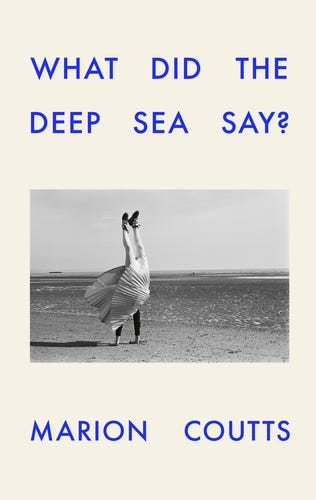
These are northerly books — Coutts was raised mainly in Scotland — very concerned with the phenomenal world, the relationship between the self and nature, sifting through the phenomenal world for language, if not understanding. In our discussion I commented that The Iceberg, had it been published today, might have been considered a novel, and on further reflection, it seems to me that What Did the Deep Sea Say, had it been published in 2014, might have been deemed a memoir. These generic boundaries are as shifting and uncertain as a shoreline.
What to call this weird space between fiction and non-? The work I’m doing now, the handful of projects I have on the go in varying stages of completion, live in this unnamed zone. They draw from my life, from my reading, from the art I’ve looked at and thought about; they are born of research and archives and city walks. They resemble Woolf’s essay-novel, or what I’ve sometimes seen termed — wait for it — autobiofictionalography. Maybe a few years ago they’d have been called autofiction, but I feel uncomfortable with the assumption that they are autobiographical, because they aren’t, something else is happening, they drift too far away from the circumstances of my life to be called that. The next one does deliberately play with the line between the real and the invented, but it does not have characters so much as it has presences, and relations. The I is not me, but I didn’t make her up. Still: it has to be an I. I cannot tell you how cringe (in a bad way) I feel using the third person. Even reading a close third person in other people’s work sometimes gives me the ick. No, it’s the first person for me. The only way out is through.
More on this via Lisa Robertson and Doireann Ní Ghríofa’s new books which are so exciting to me, as soon as I get a break from Gertrude…
How interesting! I used to think first and close third were basically interchangable, just a matter of taste. Then after my last book, I decided never again would I write in first. I love the gently ironic distance a narrator gives me -- that's when my writing feels most *me*. (I'm still fine with reading first, though.)
"Autobiofictionalography"!