
Feeling guilty
On Althusser, Claude Cahun, climate change, and why guilt can be good

We are back from vacation, which was very nice thank you; the objective was to teach our son to swim, and he is well on his way to learning. He had a glorious time in the water with his dad and a noodle. I sat on the side and offered encouragement, in between sips of rosé.
It would be impossible to say it was a vacation like any other year, however, with the fires burning in the Gironde less than 300 km away, the risk of forest fire on the Ile de Ré so high no one was allowed to light a barbecue, smoke a cigarette, or even sit in the forest. Fires dotted the map of France (as they still do). On the way back to Paris, our TGV was delayed while they put out a fire next to the tracks at Massy-Palaiseau.
We had rain one night, a glorious thunderstorm that sent rain bucketing down, soaking the laundry I’d left on the line, but I didn’t mind, I was so happy to see it. The plants were so much perkier the next day. But back in London, there were grassfires here and there, and the rain that was meant to appear didn’t, and the rain that was meant to come this week hasn’t, and there’s a hosepipe ban and we’re taking short showers and I’ve learned how to wash my dishes in a basin. And the temperatures regularly cross the 30 degree threshold. I remember, not that long ago, when that happened maybe one day per summer. It feels like this summer is the tipping point, like things have changed for good. We’ve fucked it all up, with our cars and our flights and our plastic bags and bottles and our fast fashion and our food waste and — well, you know how it goes.
So the trip was kind of a bummer. Not too much of one — we had lovely weather, no heat wave, J did learn to swim, a bit, and there was that rosé — but I was depressed. When the fire broke out in the Gironde, before we left, I couldn’t sleep for several nights. It felt so much closer to home than the fires in LA, or Australia, or Greece, or Canada. They were talking about evacuating Bordeaux. Evacuating Bordeaux! These are places I know, where people I know live. Proximity bias, I know. Guilty. I saw videos of people being evacuated from their houses in the middle of the night. I was scared for our trip: what if a fire broke out in the forest (across the street from where we were staying in Sainte Marie de Ré), how would we evacuate without a car? Then there’s the fact that the island is connected to the mainland by a bridge that gets clogged with traffic when it’s just rush hour, never mind when everyone on the island is trying to get off at the same time.
I have been thinking a lot about something someone posted on Instagram recently, about how she was feeling so full of rage and despair at climate catastrophe, and that she felt like she was the only one who felt this way. It seemed to her, she said, like people were just getting on with their lives, in the midst of these cataclysmic, man-made heat waves. By it seemed like I took her to mean: on social media, but I don’t know if this is what she meant; my own life is so circumscribed — I never really leave my house or see people who aren’t B and J — that my only sense of what things seem like is filtered through social media.
So because I assumed she was talking about the way people are acting on social media, I felt interpellated, to use Althusser’s term for when we are hailed by some authority and created as subjects within its call — as when, in his famous example, a police officer might shout “hey you!” and we turn around, because we feel he must be speaking to us. In Žižek’s reading of this essay, it’s because we know we must have done something wrong, and we have been found out. (I am probably making a right mess of all this Marxist theory, apologies.) Althusser’s point is wider than that, though:
Assuming that the theoretical scene I have imagined takes place in the street, the hailed individual will turn round. By this mere one-hundred-and-eighty-degree physical conversion, he becomes a subject. Why? Because he has recognized that the hail was ‘really’ addressed to him, and that ‘it was really him who was hailed’ (and not someone else). Experience shows that the practical telecommunication of hailings is such that they hardly ever miss their man: verbal call or whistle, the one hailed always recognizes that it is really him who is being hailed. And yet it is a strange phenomenon, and one which cannot be explained solely by ‘guilt feelings’, despite the large numbers who ‘have something on their consciences’.
This application of Althusser1, however, implies that the climate activist speaks in the name of an Ideological State Apparatus (or ISA), which usually takes the form of an institution like church or school or the media — as far as I understand, it is not a derogatory term but a descriptive one; we produce ourselves as subjects within a given society through our adherence to, say, Fox News or Jacobin. Climate discourse may have become codified as an ISA that we choose to participate in, in order to see ourselves as “green,” as environmentally considerate citizens. The “climate police,” if you’ll forgive the term, because I mean it with affection and respect, says “why aren’t you doing anything!” and the subject — me in this case — goes “but I am doing something!”
But you wouldn’t know it if you looked at my social media, you wouldn’t know how angry I am. It looks like I’m reading books and going to France and just living my summertime life. I am not. I am furious and scared and furious and so fucking furious as people drive past my house in their cars and buy shit in plastic at Sainsbury’s, lah dee dah, what climate catastrophe. Daily life is too strong to dismantle. Daily life is an ISA.
We do all the things you’re meant to do as green citizens — we recycle, we have a food waste bin and a water butt, we don’t have a car, we don’t fly, we just switched our bank from one that finances the fossil fuel industry to one that doesn’t, we talk about getting solar, a heat pump, planting more trees in the garden. But that doesn’t mean I’m not guilty. Sometimes I buy a single-use plastic bottle, or a coffee cup. Sometimes I fly to America. Sometimes I buy something at H&M or on Amazon. Sometimes I have to return things I’ve bought on H&M or Amazon. How much responsibility does each of us bear for the climate catastrophe, and for fixing it? And — to my point here — how can we fix the vibes, so it doesn’t feel like nobody is doing anything, so we can appreciate the things we’re all doing, all together, not because we’re being hounded but because we care and we want to make that care visible?
So what else we can do?
I think — hear me out — we can gently shame people.2 Or, to put it in Althusserian terms, interpellate them. I get angry when I hear people say that individual behavior won’t change anything, that the problems are structural. They are structural, of course they are, and we have to put pressure on our elected leaders to adopt better climate protections, but also: why do you think the oil companies are making so much money? Because we’re all out here buying what they’re selling! If we all changed our way of life, it would have an impact. And I think we should start feeling free to mock other people — with love and respect — until they make those changes.
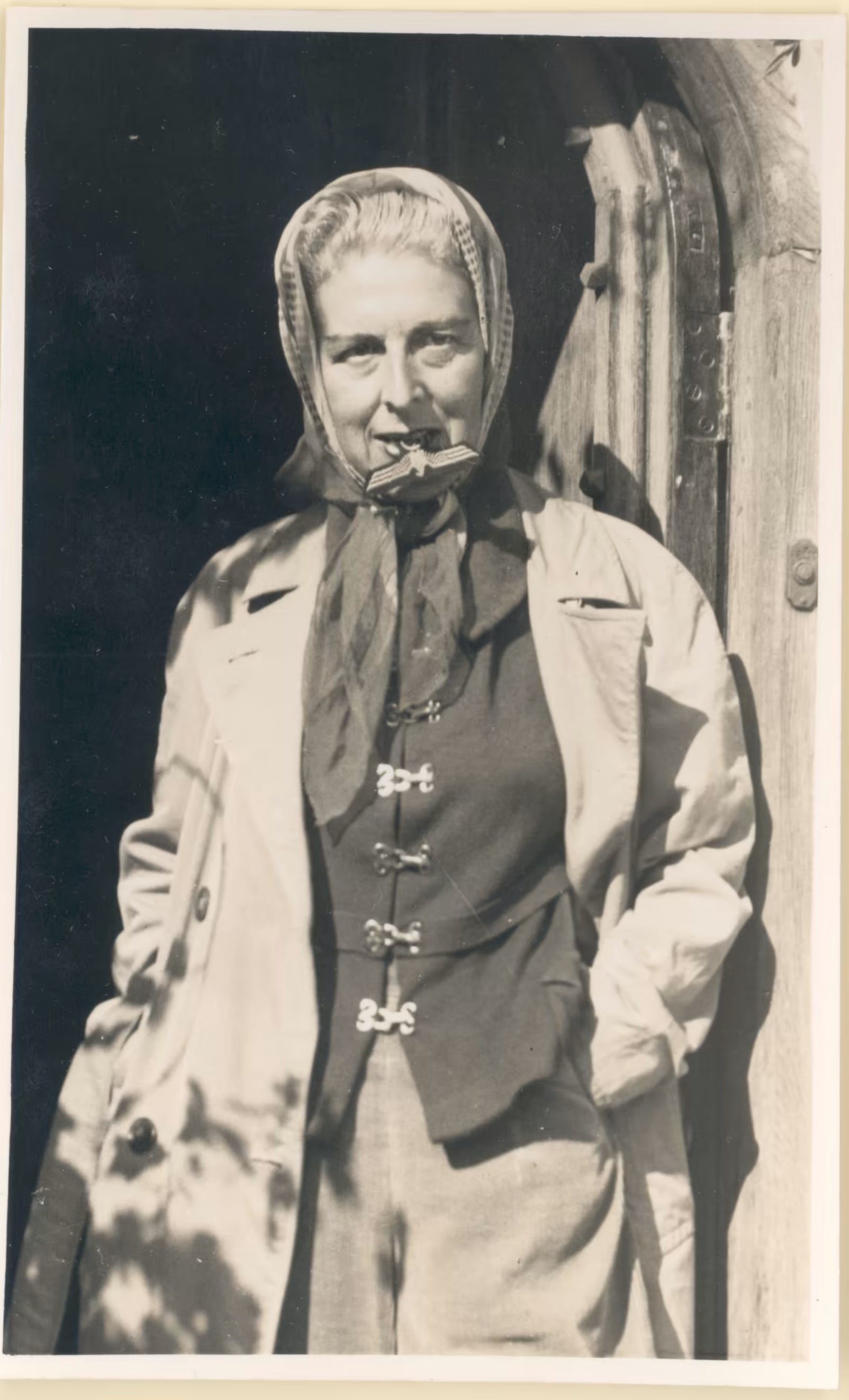
Do you know the story of Claude Cahun and Marcel Moore? How they lived on Jersey during the Occupation and conducted this two-woman resistance campaign, using their skills as artists and writers to make Surrealist tracts to convince the Nazi soldiers to give up and desert the army? They typed up hundreds of copies of pamphlets on colored paper filled with subversive poems and drawings and slogans (“Hitler guides us, Goebbels speaks for us, Goering eats for us, Himmler murders in our name, but nobody dies for us… Please spread the word”) and stuck them under windshield wipers, stacked outside the barracks, tucked into pockets and left by benches. They called themselves Der Soldat ohne Namen, the Soldier With No Name — as if the texts had been authored by a German soldier who had seen the light and become a pacifist.
The scale is too big to be able to do this with bits of colored paper, but instead of the Isle of Jersey we have the internet. We can leave comments on social media, be that reply guy, over and over, not as scolds, but in the ludic spirit of Cahun and Moore. Hashtag #thesoldierwithnoname. Be funny. But be clear. Get all your friends to do it too. We need to change people’s habits of thought, and maybe — just maybe — that might shift their habits of living.
For instance: this piece in the New Yorker pissed me off, about whether we should recline on planes. Nowhere did it suggest we shouldn’t be taking planes. That it might be morally, ethically wrong to take them — say, more than twice a year, with few exceptions. “‘If you lean back on the plane, you’re a terrible person,’ someone proclaimed, with surprising vehemence.” How about: if you take a plane and you don’t really have to, you’re a terrible person? We should bombard the New Yorker with letters until they start including in their worldview some critique of air travel.
Then there was the fashion influencer talking about how to be “cool” or at the very least “dignified” when traveling this summer on one of those low-cost airlines, “probably against your will,” as if they were about to be trussed up and tossed on board a Ryanair flight to Mallorca screaming all the while. You can’t be cool on an airplane. Airplanes aren’t cool because climate catastrophe isn’t cool. I left a little comment on her IG saying as much. 23 people liked it. One lonely commenter said: “I can’t believe I had to scroll this far down to see someone mention climate.” Everyone should have been talking about climate!
When you see people talking about how they use AI, make fun of them! When you hear someone casually say “so I asked Chat,” ask them: do you have no one else to talk to? Do your friends not know anything? Do we need to get you some new ones? I’m not saying never use AI. I suppose it has its uses, in medical research and whatnot, and in our lives as well. But we can think twice before we do. Think about the water necessary to make that query. Think about the data centres who are poisoning the people who live in them. Ask Chat your question if you really must (“is this a reasonable reading of Althusser?”) and then go fight the government’s scheme to build one on your doorstep.
I dunno, that’s just some stuff that’s top of mind for me, what do you think?
I think it’s about to rain.

yes I know he killed his wife Hélène Rytman during a psychotic break, it is very sad and he did not attempt to evade responsibility
grain of salt, people, grain of salt
Brilliant as always, Lauren. I always feel better when reading you.
Well said, and it's not nothing to do the smallest thing whenever you can. Then do it again, the next time you can. And so on. It not only adds up, but can slowly become a way of life, a way of being. And pointing out what perhaps is not being said or acknowledged (on social media, and in life) is a great idea, thanks for that. There is so much going on it is easy to feel defeated but if we are mindful of the choices we make each day it encourages us to stay in the fight.